

#1 Graphic Design and Installation in Dallas-Fort Worth
#1 Graphic Design and Installation in Dallas-Fort Worth

Standoffs are the polished metal barrels that hold a panel away from the wall, normally by three-quarters of an inch.
That small gap does two things. It lets light pass behind the panel and cast a soft shadow, so the sign appears to float rather than sit flat. And it gives the installation a deliberate, specified quality, because floating something takes hardware, and hardware implies intent.
It is a detail that costs very little, and it is the main reason an acrylic standoff sign reads as architect-specified rather than ordered online. Part of our interior graphics service, produced using direct-to-substrate printing.
Cast or extruded acrylic in clear, frosted, white, or coloured, at 1/8, 1/4, or 3/8 inch thickness.
Second surface, meaning the artwork is printed onto the back of the panel and viewed through the acrylic. The glossy face then protects the print completely, so it cannot be scratched, scuffed, or cleaned off, and the image gains a visual depth that front-surface printing never achieves.
Flame-polished for a glass-like finish, or saw-cut for a matte frosted edge. On a clear panel, the edge is a surprisingly visible part of the sign, and polished is worth the small premium.
Standoffs in brushed aluminium, polished chrome, matte black, or brass, sized to match the door furniture and fittings already in the space.
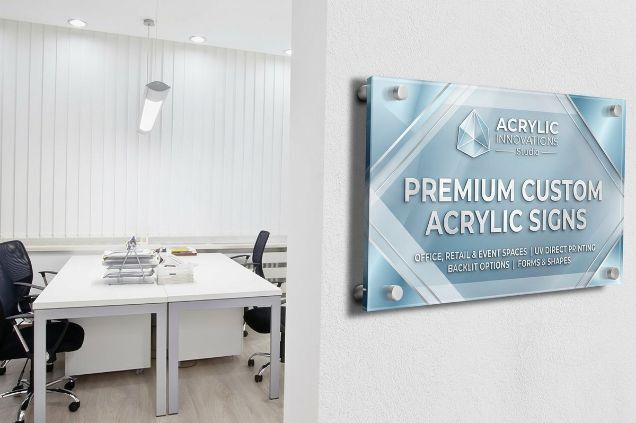
This is the specification detail that separates a good acrylic sign from a cheap-looking one, and it is invisible on a quote unless you know to check.
Up to about 18 inches wide, 1/8 inch acrylic is fine. Between 18 and 36 inches, use 1/4 inch. Above 36 inches, 3/8 inch, and additional standoffs across the span.
Under-specifying the thickness, the panel bows visibly between the standoff points. It is the single most common flaw in budget acrylic signage; it shows up worst under raking light, and it cannot be fixed after the fact. We specify thickness by size as standard rather than by budget.
Standoffs are positioned using a paper template taped and levelled on the wall. Four on a rectangular panel is standard, with more added across larger spans. Anchored into studs where the layout allows, otherwise with appropriate wall anchors sized for the panel weight.
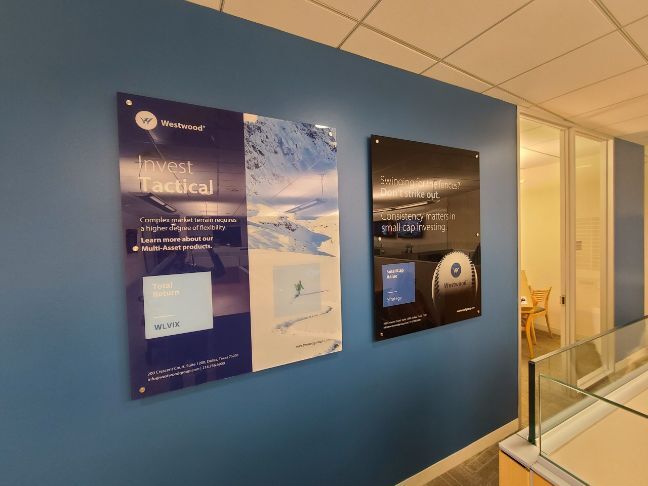
Reception and lobby logos. Conference room and office nameplates. Directory and tenant listing boards. Menu boards in restaurants and cafes. Wall-mounted award, accreditation, and certification panels. Wayfinding and floor identification. Donor and recognition walls.
ADA-compliant room signage with raised characters and Grade 2 braille is a related but separate build with specific requirements around character height, contrast, finish, and mounting position. If you are fitting out a public-facing building, ask about it specifically rather than assuming standard acrylic signage will satisfy the requirement.
Standoffs are metal barrels that hold a sign panel away from the wall, typically by three-quarters of an inch, creating a shadow gap that makes the panel appear to float. iCandy Grafix supplies them in brushed aluminium, polished chrome, matte black, and brass to match existing interior hardware.
Use 1/8 inch acrylic up to about 18 inches wide, 1/4 inch between 18 and 36 inches, and 3/8 inch above that with additional standoffs. Thinner panels bow visibly between the standoff points on larger signs, which is the most common flaw in low-cost acrylic signage.
Yes, for most interior signs. Second surface printing places the ink on the back of the panel so the image is viewed through the acrylic, which protects the print from scratching and cleaning, and gives a glass-like depth that front-surface printing cannot match.
Effectively yes. Plexiglass is a brand name that has become a general term for acrylic sheet. iCandy Grafix uses cast and extruded acrylic in clear, frosted, white, and coloured finishes for interior signage.
For small protected exterior signs and illuminated sign faces, yes. For large exposed exterior panels, no, because acrylic is brittle and moves with temperature. For flat exterior signage, iCandy Grafix specifies aluminium composite panel instead.
Copyright © 2026 iCandy Grafix. All rights reserved. Powered by Fast Hippo Media

