

#1 Graphic Design and Installation in Dallas-Fort Worth
#1 Graphic Design and Installation in Dallas-Fort Worth

Perforated film is printed vinyl punched through with thousands of small holes, giving roughly 50 percent open area. From outside, your eye reads the printed image because the exterior is brightly lit and the holes are too small to register. From inside, your eye looks through the holes toward the light, and the image largely disappears.
That is how a delivery van carries a full-colour rear window graphic while the driver can still reverse safely. Part of our fleet graphics range, and the same material used in storefront windows.
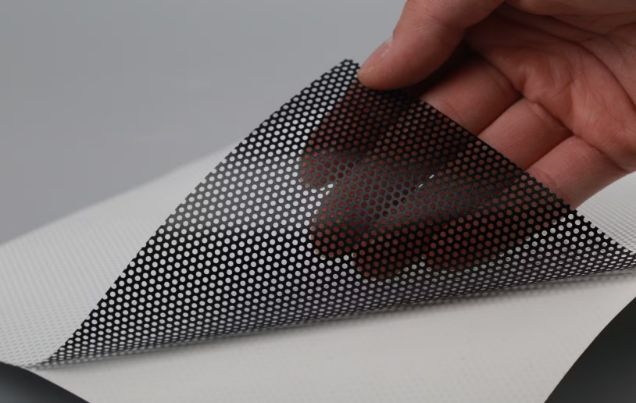
Rear windows on vans, SUVs, and box trucks are the most common application by a distance. Rear side windows on wrapped vehicles, so the graphic runs continuously across metal and glass rather than stopping awkwardly at the window line. Bus and shuttle windows. Any panel where you want an unbroken design across a mixed surface.
The visual difference between a wrap that stops at the glass and one that continues across it is significant. A design that carries over the windows reads as a single considered piece. One that stops at the window frames reads as panels stuck on a van.
During the day, from inside, you can see out clearly. It takes a few minutes to stop noticing it.
At night it is a different experience. Visibility is noticeably reduced and headlights behind you scatter slightly across the perforations. It is legal and it is safe on rear glass, and anyone who tells you it makes no difference at night has not driven one at eleven at night in the rain on 75.
This is why it goes on rear and rear-side glass, and why it does not go on driver-side windows. If your drivers are on the road late in poor conditions regularly, that is worth weighing.

Vehicle window coverage is regulated by state and local law and varies by which window. Rear windows are generally permitted on vehicles equipped with both side mirrors. Front side windows and windscreens are restricted.
Rules change and enforcement varies, so verify the current Texas Transportation Code position before committing to a design that depends on window coverage. We will produce whatever is permitted, and if a proposed layout looks like it might run into a restriction we will raise it during design rather than after installation.
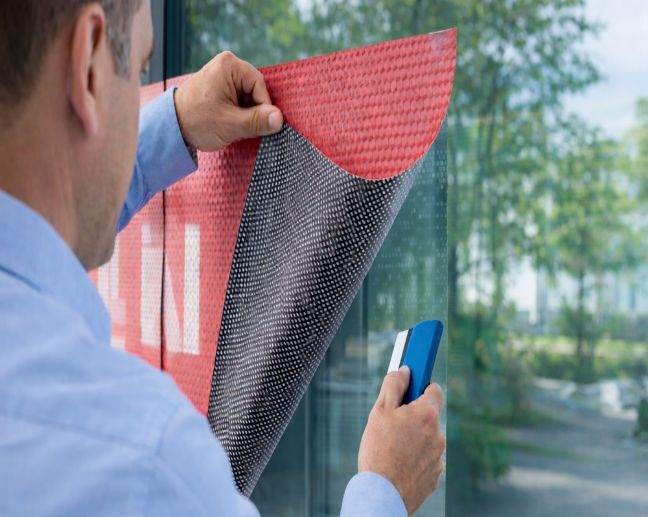
Perforated film on a vehicle must have an optically clear overlaminate. Without it, the perforations fill with road grime, dust and moisture within a few months and the print goes muddy and dark. It also becomes very difficult to clean, because you are trying to get dirt out of thousands of small holes.
We laminate all vehicle window film as standard. Expect 3 to 5 years from laminated perforated film, which is shorter than body graphics because the material takes more abuse and the perforations are inherently more vulnerable.
Wash normally. Do not use a squeegee or a scraper on perforated film, and do not aim a pressure washer at it. If the perforations do collect grime, a gentle wash with soapy water and a soft cloth is the right approach, worked in one direction rather than scrubbed.
Yes, during daylight. Perforated film is around 50 percent open area, so from inside you see out clearly while the printed image reads solid from outside. Visibility is reduced at night when the lighting balance reverses, which is why it is used on rear windows rather than driver-side glass.
Perforated film is generally permitted on rear windows of vehicles equipped with both side mirrors, while front side windows and windscreens are restricted. Rules are set by state law and can change, so verify current requirements before ordering. iCandy Grafix produces to whatever coverage is permitted.
Laminated perforated film lasts 3 to 5 years on a vehicle, shorter than body graphics because the perforations are more vulnerable to grime and abrasion. Lamination is critical, and iCandy Grafix applies an optically clear overlaminate to all vehicle window film as standard.
No. Windscreens and front side windows are restricted under state law. Perforated film is used on the rear and rear-side glass only.
Slightly the opposite, in most cases. The film blocks a portion of direct sunlight through the treated glass, which tends to reduce interior heat gain a little rather than increase it.
Copyright © 2026 iCandy Grafix. All rights reserved. Powered by Fast Hippo Media

