

#1 Graphic Design and Installation in Dallas-Fort Worth
#1 Graphic Design and Installation in Dallas-Fort Worth

Standard vinyl disappears at night. Whatever you paid for it, once the sun goes down, your vehicle is an anonymous dark shape.
Reflective vinyl has a microprismatic or glass bead layer that returns headlight light directly back toward its source, so your name, your outline, and your markings light up from several hundred feet away. For any operation where crews park on a shoulder, work roadside, or run after dark, this is a safety product first and an advertising product second.
Part of our fleet graphics service.
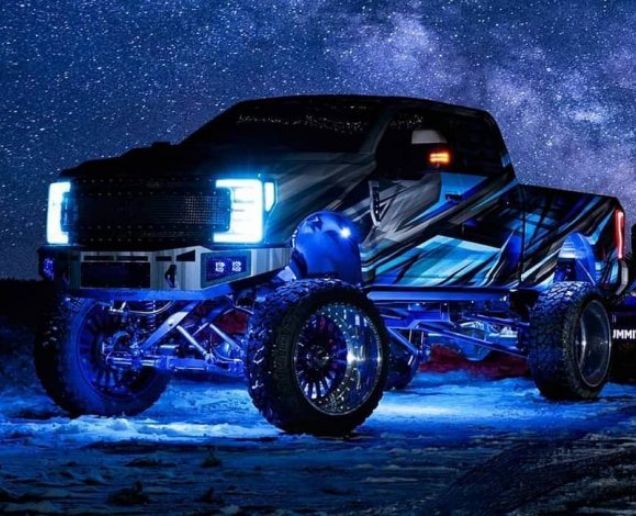
Reflective cut lettering and logos. Company name, phone, and unit markings cut from reflective film.
Printed reflective graphics. Full colour printed over a reflective base, so the design reads normally in daylight and reflects at night.
Chevron kits. Alternating diagonal panels for rear-facing surfaces on emergency and highway service vehicles.
DOT conspicuity tape. Red and white alternating tape for trailers and box trucks, applied to the specified pattern and coverage.
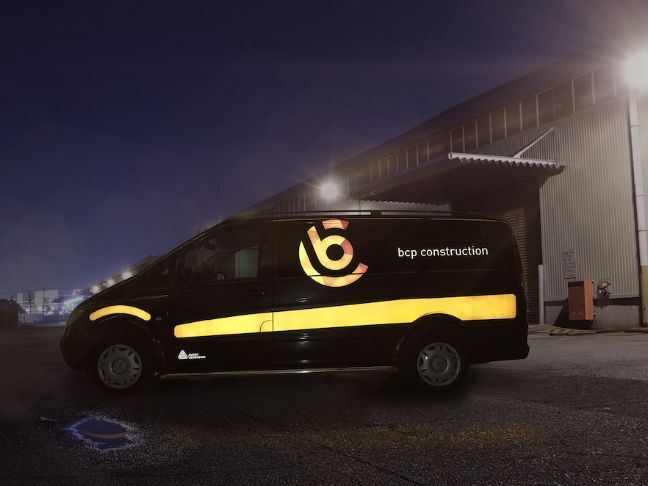
Reflective outlines and accent striping. A cost-effective middle ground, outlining the vehicle’s silhouette so its shape is visible at night without covering it in reflective film.
Reflective DOT numbers and unit markings.
Utility and municipal fleets. Tow and recovery operators, who spend a great deal of working time on the shoulders of 75 and 121 in the dark. Fire, EMS, and security. Roadside assistance. HVAC and plumbing companies are running emergency call-outs at night. Construction and highway maintenance. Trailer fleets meeting federal conspicuity requirements. School district and transit vehicles.
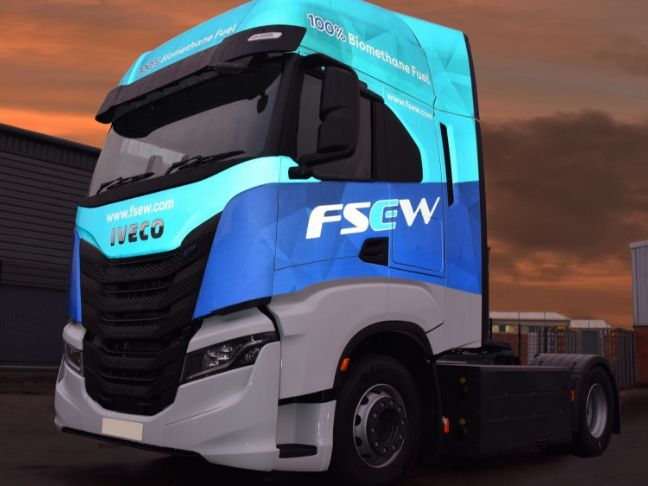
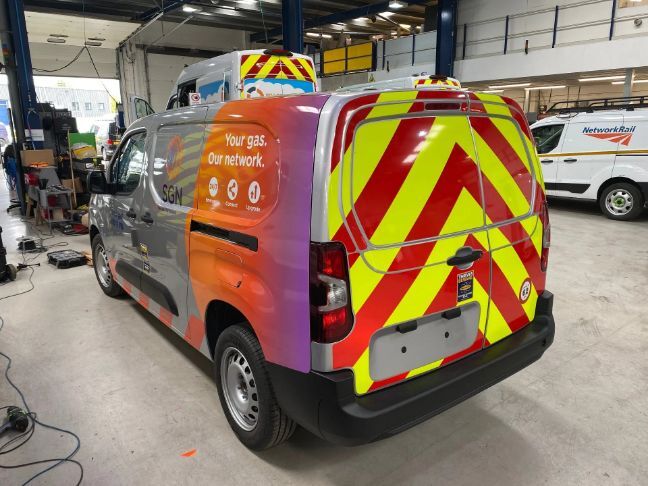
The standard pattern for rear-facing surfaces on emergency and highway service vehicles is alternating reflective red and yellow, at 45 degrees, covering a specified proportion of the rear face.
Exact requirements vary by agency, jurisdiction and vehicle type, and some organisations have their own internal standard that differs from the common one. Tell us which standard you are working to and we will build to it precisely. If you are not sure which applies, check with the relevant authority first, because getting a chevron kit wrong means doing it twice.
Reflective film costs meaningfully more per square foot than standard vinyl. Wrapping an entire vehicle in it is rarely the right call financially, and it is often not the right call visually either.
What most fleets do, and what we would recommend, is apply it selectively. Rear surfaces, where a following driver most needs to see you. The company name. An outline stripe around the vehicle silhouette. That approach gets you the majority of the night visibility benefit at a fraction of the cost of full reflective coverage.
Full colour can be printed onto a reflective base, which works well. The one thing to understand is that heavy ink coverage reduces how much light gets back through the film, so a graphic printed in deep saturated colours reflects less strongly than one with light areas.
We design around this. Where night visibility genuinely matters, we keep the critical elements, meaning the name and the outline, in lighter colours or in uncoated reflective film, and use the saturated colours in areas where reflectivity is less important.
Reflective vinyl contains a microprismatic or glass bead layer that returns headlight light directly toward its source, making the graphic highly visible at night. iCandy Grafix uses it for lettering, chevron kits, outline striping and conspicuity markings on service, utility and emergency vehicles.
Federal regulations require red and white conspicuity tape on the rear and sides of most trailers over 80 inches wide with a GVWR above 10,000 lbs. iCandy Grafix supplies and applies DOT-compliant conspicuity tape, though confirming which rules apply to your specific equipment is the operator’s responsibility.
Yes. Full-colour graphics can be printed onto a reflective base film, so the design reflects at night and reads as normal colour in daylight. Reflectivity is reduced under heavy ink coverage, so iCandy Grafix designs the critical elements in lighter colours where night visibility matters most.
Rarely. Reflective film costs considerably more per square foot, and most of the safety benefit comes from rear surfaces and an outline stripe. iCandy Grafix generally recommends applying reflective selectively rather than across the whole vehicle.
Reflective film on a vehicle typically lasts 5 to 7 years, similar to standard cast wrap film, though reflectivity gradually reduces over that period as the surface weathers. Keeping it clean makes a noticeable difference in how well it performs at night.
Copyright © 2026 iCandy Grafix. All rights reserved. Powered by Fast Hippo Media

