

#1 Graphic Design and Installation in Dallas-Fort Worth
#1 Graphic Design and Installation in Dallas-Fort Worth

A flat printed panel with your name on it is a sign. Individual letters standing off a wall, catching light from the side and throwing a shadow behind them, read as permanent and deliberate.
Most people cannot articulate why one looks more expensive than the other. It is the shadow. Depth signals that somebody made a decision and paid for fabrication rather than printing.
Part of our signs, letters and graphics range and the single biggest perceived-quality upgrade available on a building fascia or a reception wall.
Cut from a single solid sheet, mounted flush against the wall or held off on studs. Available in acrylic, PVC, aluminium, brass, stainless and wood.
The most common and the best value. For interior work and non-illuminated exteriors, this is usually the right answer, and the stud-mounted version with a shadow gap gets most of the visual benefit of far more expensive options.
Hollow letters with formed sides, called returns, and a separate face. Almost always aluminium. Built to house LED lighting inside, and the standard for illuminated storefront fascia signage.
LEDs mounted inside the letter throwing light onto the wall behind it, so the letter reads as a solid silhouette surrounded by a glow. The most impressive lit option and the most expensive. It needs power run into the wall behind the sign, which means planning it during fit-out rather than deciding on it afterwards.
Translucent acrylic face with LEDs inside, so the letter itself glows. The classic retail storefront look and the most visible option at night from a distance.
Cut to any shape, layered at different depths for dimension, printed or painted. Often paired with flat cut lettering for the wordmark.
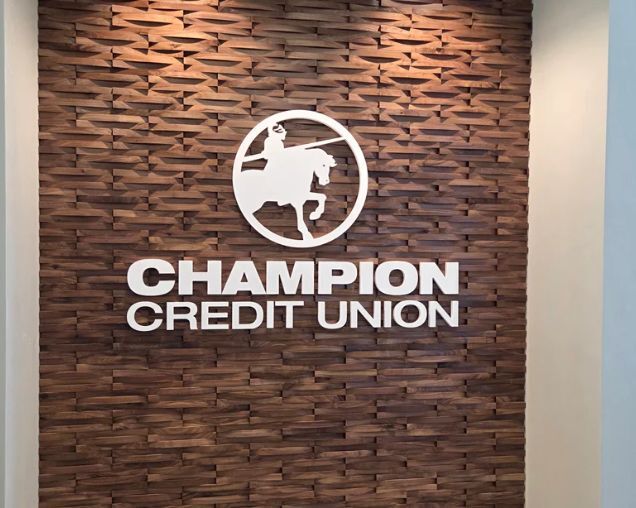
PVC, $30 to $80 per letter. Painted foam PVC. Interior use in practice. From ten feet away it reads as painted metal, and it is the option that lets a smaller business have a dimensional sign at all. We recommend it more often than the trade generally admits.
Painted or laminated acrylic, $50 to $150. Clean edges, wide colour range, interior or protected exterior.
Brushed or painted aluminium, $80 to $300. The corporate standard. Weatherproof, permanent, substantial.
Stainless steel, premium. For banks, law firms and high-end retail where the material itself is part of the message.
Halo or face-lit, $200 to $500 per letter fabricated, plus electrical.
Allow roughly one inch of letter height for every ten feet of viewing distance, then check it against your permitted sign area before committing.
That second step catches people out. You can calculate a beautiful 24-inch letter height for a building set 200 feet back from the road, and then discover the city allows you 40 square feet total on that frontage and your wordmark needs 65.
Work out the permitted area first, then size the letters to fit it, then check the result is still legible from the road. If it is not, the answer is usually fewer words rather than smaller letters.
Flush mount. Letters sit tight against the wall with no gap. Cleanest where the wall itself is a feature and where the letters are thick enough to read as dimensional on their own.
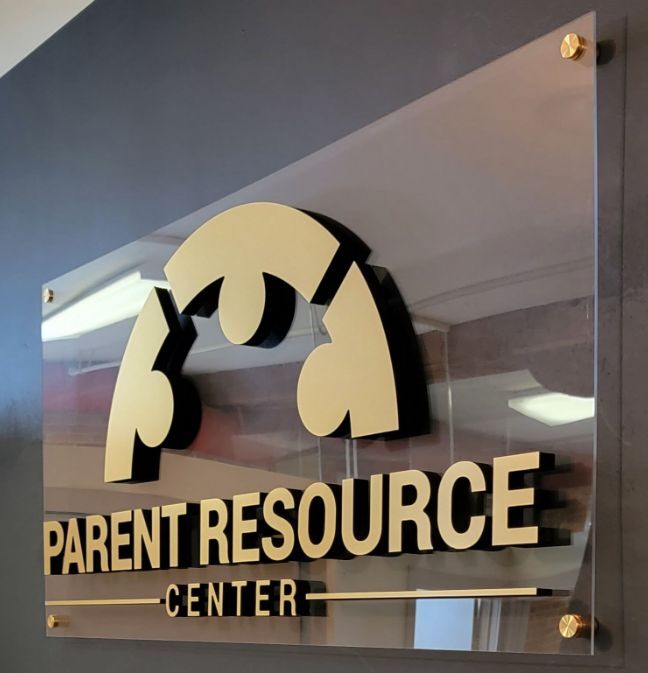
Stud mount. Threaded rods set into the back of each letter, into drilled holes, holding the letter off the wall by a specified distance. Creates the shadow gap. The most secure method for heavier letters and the best-looking for most applications.
VHB tape. Very high bond tape for lightweight interior letters on smooth surfaces. Fast, no holes, and the right answer in leased premises where drilling is restricted.
Raceway mount. Letters mounted to a horizontal channel that houses the wiring and fixes to the building with fewer penetrations. Common on illuminated storefront signage and often required by landlords who do not want dozens of holes in the fascia.
Every installation begins with a full-size paper pattern taped to the wall and levelled with a laser.
The pattern shows exactly where each hole goes. It gets checked, adjusted, stepped back from and looked at from the road, and only then does anyone pick up a drill.
Letters installed by eye end up subtly crooked or unevenly spaced, and once the holes are in masonry the mistake is permanent. This is the least glamorous part of the job and the one that determines whether the sign looks right for the next fifteen years.
Dimensional letters typically cost $30 to $80 per letter in PVC, $50 to $150 in acrylic, $80 to $300 in aluminium, and $200 to $500 for illuminated letters. Price depends mainly on letter height, material and depth, and iCandy Grafix quotes each sign as a complete set rather than strictly per character.
Flat cut letters are cut from a single solid sheet and mounted directly to the wall. Channel letters are hollow fabricated shells with formed sides and a separate face, built to house LED lighting. Flat cut letters cost less and suit interiors and non-illuminated exteriors, while channel letters are used for lit storefront signage.
Letters are mounted flush, on threaded studs for a shadow gap, with VHB tape for lightweight interior applications, or on a raceway that houses the wiring. iCandy Grafix installs using a full-size paper pattern taped and levelled on the wall, so hole positions are exact before any drilling begins.
Allow roughly one inch of letter height per ten feet of viewing distance, then check the result against your city’s permitted sign area for that frontage. Permitted area is usually the binding constraint, so calculate it first and size the letters to fit rather than the other way round.
Yes, with the right material. Aluminium and acrylic are suitable for exterior use, while PVC is better kept to interiors since it degrades in sustained Texas sun. iCandy Grafix specifies by location rather than by budget alone.
Dimensional letter signs take 2 to 3 weeks after proof approval because of fabrication, and illuminated letters the same plus electrical coordination. Add permitting time for exterior signage, which sits outside our control and varies by city.
Copyright © 2026 iCandy Grafix. All rights reserved. Powered by Fast Hippo Media

