

#1 Graphic Design and Installation in Dallas-Fort Worth
#1 Graphic Design and Installation in Dallas-Fort Worth

Drivers filter out static signage. It is a well-documented behaviour and you do it yourself every day without noticing. What people do not filter out is movement in peripheral vision, because the visual system treats it as potentially important.
That is the whole reason feather flags work at roadside, and it is why car dealerships, phone stores, gyms, restaurants and new developments across Collin County line their frontage with them. Part of the iCandy Grafix banners and flags range.
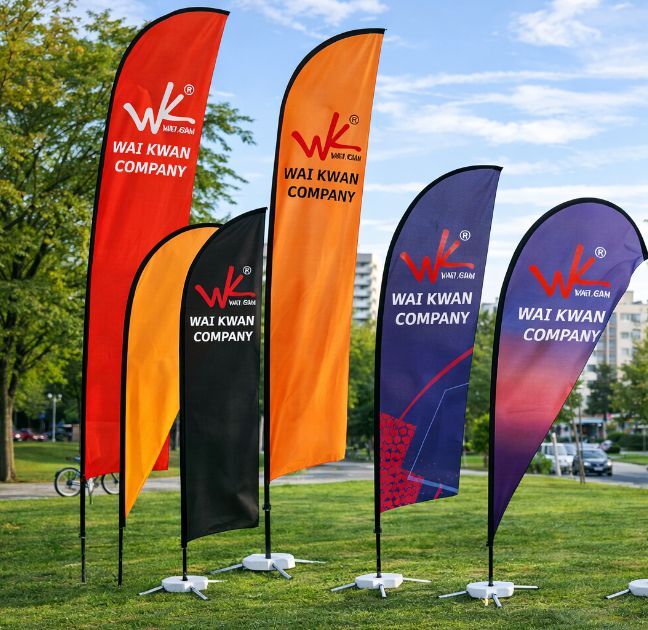
Tall, curved along the top edge, tapering to a point at the base. The most common shape and the one that flies best in light wind, which matters because most days are light-wind days. The curve does distort text slightly, so it suits a logo or one or two words rather than a phone number.
Rounded outer edge, held taut against the pole on all sides. Holds its shape better in strong wind and, importantly, stays fully readable when the air is completely still. If your message needs to be legible rather than just eye-catching, teardrop is the safer choice.
Covered separately on our rectangle flags page.
This is where most feather flag problems come from, and it is entirely avoidable.
Ground spike. For grass and soft ground. Cheapest option and by far the most stable, because it is anchored into the earth.
Cross base. For indoor hard floors only.
Cross base with weight bag or water tank. For outdoor concrete and asphalt. This is the one people get wrong. A bare cross base on a windy parking lot will go over, and when it goes over a 14-foot pole falls onto whatever is beside it, which is frequently a customer’s car.
Vehicle tyre base. A steel plate you park a vehicle on. Effectively immovable, and the correct answer for permanent dealership or storefront frontage.
If your flag is going on concrete, budget for the weight from the start rather than discovering the problem in March.
Small around 8 feet, medium 10 to 12 feet, large 14 to 17 feet.
For roadside frontage, go 14 feet or taller. Anything shorter competes with parked cars, landscaping and the vehicles in your own lot, and gets lost. For a market stall, an indoor expo or a school event, 8 to 10 feet is right, and anything taller will run into a ceiling grid or a tent canopy.
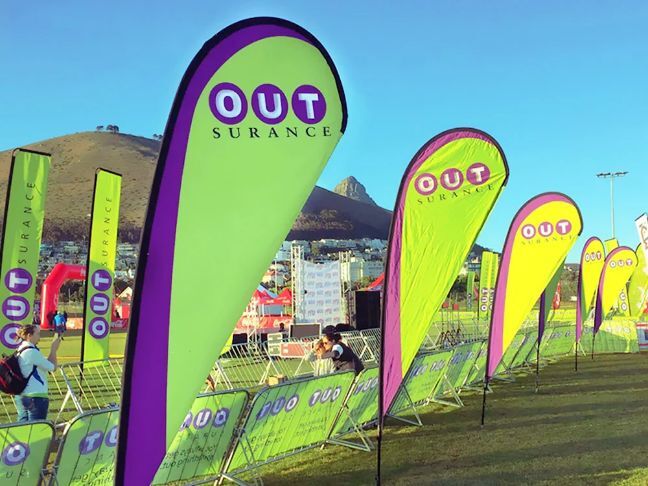
A single-sided flag prints through the fabric, so the reverse shows a mirror image. For a logo that is often fine and nobody notices. For any text, a phone number or a website, it means half your audience reads it backwards.
Double-sided flags use a blockout layer between two separate prints, so both faces read correctly. They cost roughly 40 to 60 percent more, and they are worth it anywhere with two-way traffic, which is most roadside positions.
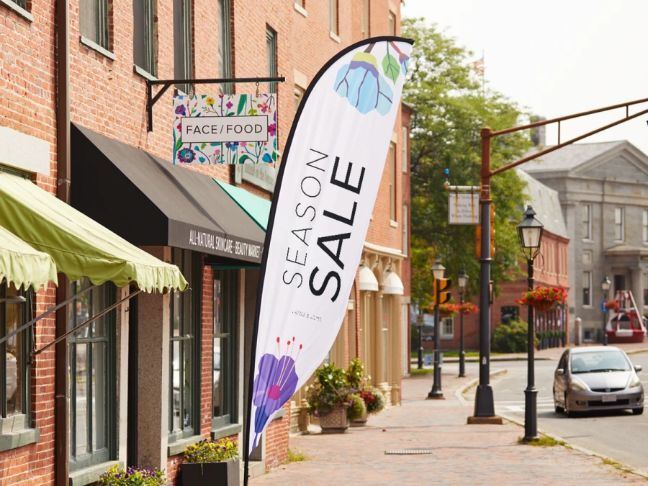
6 to 18 months in constant outdoor use in North Texas. Two things wear them out: sun fading the print, and constant flexing wearing the fabric along the fly edge.
Taking flags down in high wind and storing them between events extends life dramatically. Clients who put flags out during opening hours and bring them in at close routinely get two or three years from a set.
Feather flags come in 8 foot, 10 to 12 foot, and 14 to 17 foot heights. iCandy Grafix recommends 14 feet or taller for roadside visibility where traffic passes at speed, and 8 to 10 feet for indoor events, markets and trade shows where ceiling height is a constraint.
On concrete or asphalt, use a cross base with a water or sand weight bag. A bare cross base is not heavy enough for outdoor use and will tip in moderate wind, bringing a 14-foot pole down onto whatever is beside it. For permanent frontage, a vehicle tyre base is the most secure option.
Feather flags last 6 to 18 months in constant outdoor use in North Texas. Sun fades the print and constant flexing wears the fly edge. Taking flags down in high wind and storing them between uses can extend that to two or three years.
Single-sided flags show a mirrored image on the reverse, which is acceptable for a logo but means text reads backwards from one side. Double-sided flags use a blockout layer so both faces read correctly, and iCandy Grafix recommends them for any roadside position with two-way traffic.
A feather flag has a curved top and tapers to a point, catching light wind well and creating movement. A teardrop flag is held taut on all sides, holds its shape in strong wind and stays readable when the air is still. Choose feather for attention and teardrop for legibility.
Copyright © 2026 iCandy Grafix. All rights reserved. Powered by Fast Hippo Media

