

#1 Graphic Design and Installation in Dallas-Fort Worth
#1 Graphic Design and Installation in Dallas-Fort Worth

An acrylic panel with flame-polished edges, printed on the back so the image sits beneath a glossy face, held off the wall on brushed metal standoffs.
A few hundred dollars, and it reads as a considered part of the interior rather than a sign somebody ordered. There is very little else in signage that returns that much perceived quality per dollar, which is why it is the most common specification for professional service interiors across the Metroplex.
Part of our signs, letters and graphics range, and the same build described on our acrylic standoff signs page.
Glass-like, and the standard for lobby and office signage. Printed second surface so the panel face protects the image.
Softer, hides fingerprints, and excellent for privacy panels and professional services where clear glass feels too exposed. Also the better choice in rooms with strong directional lighting, since it does not throw a hotspot.
Where a solid background is wanted and the panel is doing the job of a printed board with a better edge finish.
Matte face, for bright rooms and positions under downlights.
Multiple acrylic pieces mounted at different depths for a dimensional effect. Effective for logo marks where a single flat panel would be too plain.
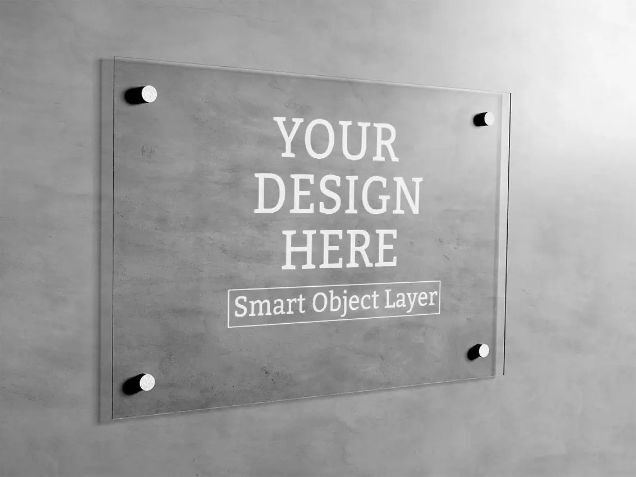
On clear acrylic we print on the back of the panel, so the artwork is viewed through the material.
This does two things. The glossy face protects the print completely, so it cannot be scratched, scuffed or cleaned off, which matters in a public area where the sign will be touched. And the image gains a depth and a slight refraction that front-surface printing simply cannot reproduce.
The file has to be mirrored and the colour sequence reversed, with white laid last rather than first. That is a production consideration on our side, and the reason the proof we send back may look different from the file you supplied.Requires white ink capability. See direct to substrate printing.
Flame-polished edges look like glass and cost a little more.
Saw-cut edges are matte and slightly frosted in appearance.
On a clear panel the edge is a surprisingly visible part of the sign, particularly when light catches it, and polished is worth paying for. On an opaque coloured panel it matters much less.
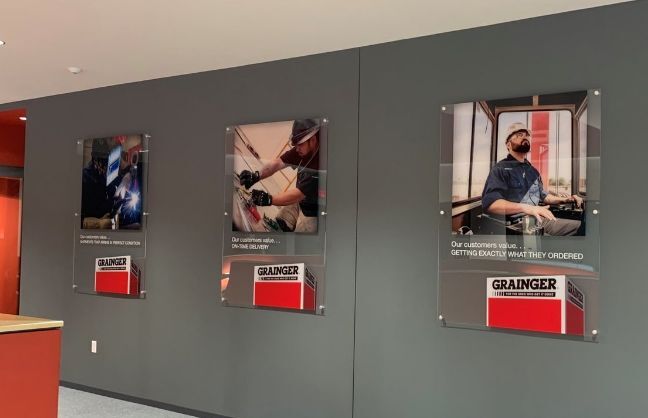
Up to about 18 inches wide, 1/8 inch acrylic is fine. Between 18 and 36 inches, use 1/4 inch. Above 36 inches, 3/8 inch with additional standoffs across the span.
Under-specify and the panel bows visibly between the standoff points. It shows worst under raking light, it is the most common flaw in low-cost acrylic signage, and it cannot be corrected once the panel is made.
Raised character and braille signage for public buildings is a related but distinct build, with specific requirements covering character height, stroke width, contrast, finish, braille type and mounting position relative to the door.
It is not something a standard acrylic panel satisfies by accident. If you are fitting out a public-facing building, ask about it specifically at the start rather than discovering the requirement at inspection.

Large exposed exterior panels. Acrylic is brittle, it expands and contracts significantly with temperature, and it becomes expensive quickly at scale. For flat exterior signage use ACM.
Effectively yes. Plexiglass is a brand name that has become a general term for acrylic sheet. iCandy Grafix uses cast and extruded acrylic in clear, frosted, white and coloured finishes for interior signage.
On the back, in most cases. Second surface printing places the ink behind the panel so the image is viewed through the acrylic, which protects the print from scratching and cleaning and gives a glass-like depth. Front printing is used only where the acrylic itself is opaque.
For small protected exterior signs and illuminated sign faces, yes. For large exposed exterior panels, no, because acrylic is brittle and moves considerably with temperature. iCandy Grafix specifies aluminium composite panel for permanent flat exterior signage.
Use 1/8 inch up to about 18 inches wide, 1/4 inch between 18 and 36 inches, and 3/8 inch above that with additional standoffs. Thinner panels bow visibly between standoff points, which is the most common flaw in low-cost acrylic signage.
Acrylic on standoffs suits most interiors, photographs well and sits in a mid price band. Brushed aluminium gives a heavier, more corporate presence at a higher cost. iCandy Grafix will usually recommend acrylic unless the interior specifically calls for the weight of metal.
Copyright © 2026 iCandy Grafix. All rights reserved. Powered by Fast Hippo Media

