

#1 Graphic Design and Installation in Dallas-Fort Worth
#1 Graphic Design and Installation in Dallas-Fort Worth

Run-out flags, sideline flags, tailgate flags, and the ones flying at the stadium entrance on a Friday night.
A flag does something a banner cannot, which is move. On a still evening it hangs and reads as decoration. On a breezy one it is the most visible thing on the field, and that is exactly when a stadium is at its busiest.
Part of our school spirit and team sports range, closely related to our rectangle flags and feather flags.
Large, on a lightweight pole, carried by a student ahead of the team. Usually 3×5 feet or larger. These take real abuse, get carried at speed and occasionally get dropped, so reinforced stitching matters more here than on anything else in the range.
3×5 feet, the size everybody knows, with grommets or a pole sleeve. Suits flagpoles and handheld use equally.
3×5 on a portable pole with a weighted or spike base. Popular with booster clubs marking a tailgate area, and with parent groups at away games.
Tall vertical flags marking stadium entrances, ticket gates and parking. See feather flags.
12×18 inches, for family front yards. One of the better fundraising items in this category, because they are cheap to produce, parents buy them readily, and every one is a small advertisement for the programme on a residential street.
Small window-mount flags for game day convoys and playoff runs.
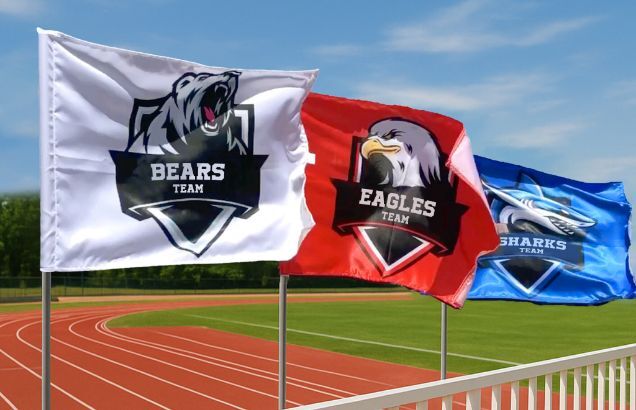
Knitted polyester, dye sublimated, so the ink goes into the fibre and the design shows on both faces. Reinforced heading with brass grommets, or a sewn pole sleeve depending on the mount.
Double-stitched hems throughout, and a four-row stitch on the fly edge for anything flying full time outdoors. The fly edge is always what fails first on a flag, because it takes the most movement, and the additional stitching there adds meaningfully to the working life.
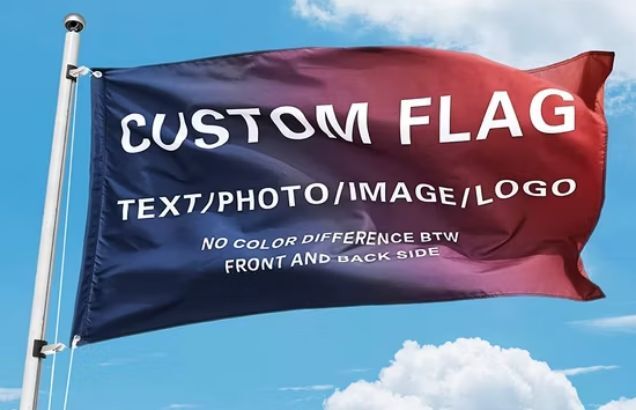
A standard dye sublimated flag shows a mirrored image on the reverse. For a mascot silhouette or a symmetrical crest, nobody notices.
For a wordmark, a school name or a number, half your audience reads it backwards. In that case we build a true double-sided flag with an opaque blockout layer between two separate printed faces, which costs more and is worth it for anything with text.
A quality polyester flag flown continuously outdoors lasts around 6 to 12 months in North Texas, with wind causing more wear than sun.
Flags brought in between events last several years. For run-out flags used a dozen times a season and stored in a locker in between, expect them to outlast the players who carried them.
The standard team flag is 3 by 5 feet, which suits both flagpole and handheld use. Run-out flags carried onto the field are often larger at 4 by 6 feet, and garden flags for family lawns are typically 12 by 18 inches.
Knitted polyester with dye sublimated printing, because the ink bonds into the fibre so it will not crack or peel, and the fabric flies well in light wind. Reinforced four-row stitching on the fly edge is important, since that is where flags wear out first.
A quality polyester flag flown continuously outdoors lasts 6 to 12 months in North Texas, with wind causing more wear than sun. Flags taken down and stored between events last several years, which is why run-out and tailgate flags outlive permanently flown ones.
For a symmetrical mascot or crest, single-sided is fine, since the mirrored reverse is not noticeable. For any flag carrying a school name, wordmark or number, choose true double-sided construction with a blockout layer, or half your audience reads it backwards.
Yes, and they work well. Garden flags are cheap to produce, parents buy them readily, and each one sits on a residential lawn advertising the programme. iCandy Grafix offers wholesale pricing on bulk runs intended for resale.
Copyright © 2026 iCandy Grafix. All rights reserved. Powered by Fast Hippo Media

