

#1 Graphic Design and Installation in Dallas-Fort Worth
#1 Graphic Design and Installation in Dallas-Fort Worth

Stand across the road from your own shop for five minutes and watch what happens. Cars slow at the light. People walk past on the phone. A driver looking for a parking space scans the whole row of frontages in about two seconds.
In those two seconds, your storefront either identified itself or it did not.
Most businesses use maybe five percent of the glass they are paying rent on. A vinyl logo on the door, sometimes a faded promotional poster taped up inside. Meanwhile, there are two hundred square feet of window facing a road carrying fourteen thousand cars a day, doing nothing.
iCandy Grafix designs, prints, and installs storefront window graphics for retail stores, restaurants, gyms, salons, medical practices, and offices across McKinney, Frisco, Allen, Plano, Prosper, and the wider Dallas-Fort Worth Metroplex. Everything is produced in our own shop in Anna, TX, and installed by our own crew. Window graphics typically run 3 to 5 business days from proof approval.
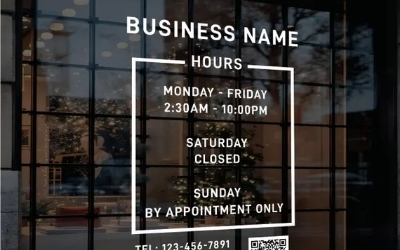
What it does: Hours, phone, socials, payment icons on the entry door
Typical spend: $80 to $200
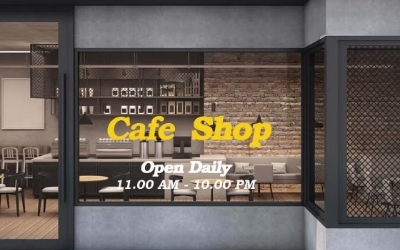
What it does:
Cut vinyl name, logo, and services on the glass
Typical spend: $150 to $600
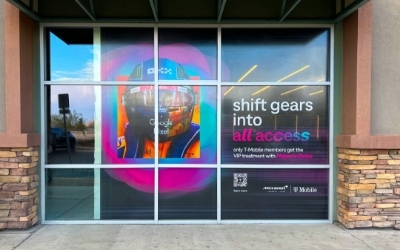
What it does:
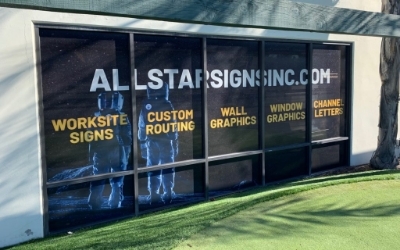
Printed graphics, frosted film, perforated one-way vision
Typical spend: $8 to $15 per sq ft
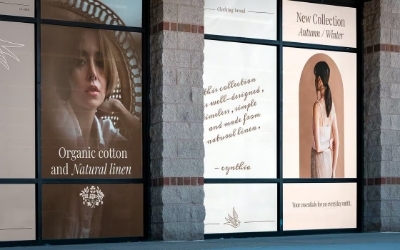
What it does:
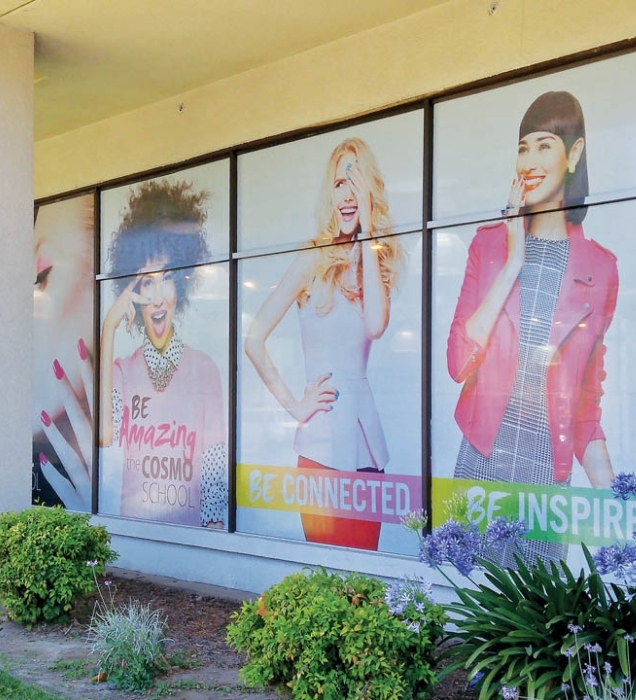
Full edge-to-edge coverage of the glass
Typical spend: $600 to $2,500z
What it does:
Graphics on the building face itself
Typical spend: $12 to $25 per sq ft
We have installed enough of these to have a strong opinion about the order in which things should be done. Here is the method we walk clients through, and it costs nothing to apply before you order anything.
Look at your frontage as three zones and give each one a single job. Almost every underperforming storefront we are called to fix has these zones confused or reversed.
The top band is about six feet above: This is your name and logo, and it needs to be large. This band is read from a moving car, from across a parking lot, and from the far end of a shopping centre. Nothing subtle belongs here, and nothing small survives here.
The middle band, roughly four to six feet: This is eye level, and the default answer is to leave most of it clear. If your interior is part of the sale, meaning a restaurant with a full dining room, a salon mid-appointment, or a busy gym, then people need to see it. Social proof through glass converts. If your interior is not the selling point, this band becomes prime space for printed graphics and product imagery.
The bottom band, below four feet: Hours, phone, payment methods accepted, social handles, licence numbers, delivery partners. Read close up by somebody already standing at the door, deciding whether to come in.
The pattern we see constantly is a small logo placed at eye level, nothing at all in the top band, and no hours anywhere. That storefront is invisible from the road and ambiguous from the pavement, which is the worst of both.
This decision drives the material choice more than anything else, and getting it wrong is expensive because it means removing and reprinting.
Cut vinyl lettering blocks almost no light, since only the letters themselves are opaque. Perforated one-way vision film reduces daylight through the treated glass by roughly half. A fully opaque wrap blocks it entirely.
A north-facing frontage in a shopping centre with weak interior lighting cannot afford to lose half its daylight. A south-facing frontage that overheats every afternoon in July might genuinely benefit. Look at your space at the time of day you are busiest before choosing.
This is the step people skip, and it is the one that costs real money.
Most shopping centres cap tenant window coverage, commonly somewhere between 25 and 50 percent. Many city sign ordinances do the same. Both can apply at once, and the stricter one wins.
We have been called out to install a full window wrap that the property manager required the tenant to remove eight days later. That is a bad afternoon for everybody and it was entirely avoidable with one email. Get written approval before ordering anything above about a quarter coverage, and iCandy Grafix will design to whatever limit applies.
Glass looks clean and almost never is. Storefront glass carries a film of cleaning product residue, particularly where ammonia-based cleaners have been used, and vinyl applied over that residue will fail at the edges within months.
Our process on every window job: the glass is cleaned with a non-ammonia solution, scraped where necessary, then wiped and dried completely. Large graphics are applied wet, which allows repositioning before the adhesive sets. Smaller cut vinyl goes on dry. Everything is squeegeed from the centre outward to drive air to the edges, and the edges are sealed.
Anything over about 24 inches wide is a two-person job, and we send two people. A single installer wrestling a four-foot graphic onto glass alone is how you get creases you cannot remove.
We schedule around trading hours. Nobody wants an installation crew across their entrance at midday on a Saturday, and we would rather come in at seven in the morning or after closing.
Cut vinyl window lettering typically costs $150 to $600 for a storefront, printed window graphics run $8 to $15 per square foot installed, and a full window wrap ranges from $600 to $2,500 depending on total glass area. iCandy Grafix quotes by measured pane sizes, material, and whether the application is interior or exterior, and most storefront quotes come back the same business day.
It depends entirely on the material. Cut vinyl lettering blocks almost no daylight because only the letters are opaque. Perforated one-way vision film reduces light through the treated glass by roughly half. Fully opaque vinyl blocks it completely, which is why it is normally limited to secondary panels rather than a whole frontage.
Window graphics applied to the inside of the glass last 5 to 7 years, and exterior-applied graphics 3 to 5 years in North Texas sun. iCandy Grafix recommends interior application wherever the design allows, since it protects the vinyl from weather, cleaning, and physical damage.
No. Vinyl removes from glass cleanly using gentle heat and a plastic blade, leaving adhesive residue that cleans off with the correct solvent. iCandy Grafix offers professional removal, which matters most on old graphics that have been baking on a south-facing window for years and have hardened.
Yes. Perforated one-way vision film gives a full printed image on the outside while remaining largely see-through from inside during daylight. It is the standard solution for storefronts wanting large graphics without closing off the interior view, and it is used on our window graphics product.
Most shopping centre leases and many city sign ordinances cap tenant window coverage between 25 and 50 percent, and where both apply, the stricter limit governs. Check your lease and your city’s sign code before ordering, and iCandy Grafix will design to whatever coverage limit applies to your site.
Most storefront installations are completed in a single visit of two to four hours. Larger full-frontage wraps on multi-pane glass can take a full day. iCandy Grafix schedules installations around your trading hours, including early mornings and after close.
Send a straight-on photo of your frontage with something in shot for scale, tell us roughly what your glass measures, and say what you want people to notice first. We will come back with what it costs and what it will look like.
Copyright © 2026 iCandy Grafix. All rights reserved. Powered by Fast Hippo Media


